3. Maths4ML: Dot Product
#Drawbacks of Rulers (Euclidean Distance)
#Example :
There is data of 2 people listening to music :
| Person A | Person B | |
|---|---|---|
| Time per day | 5 hours (300 mins) | 10 mins |
| jazz | 270 mins (90%) | 9 mins (90%) |
| pop | 30 mins (10%) | 1 min (10%) |
When plotted on a graph where axes are min. of jazz & min. of pop, then person A & B are miles apart.
The Euclidean distance between them will be huge.
- It tells how much physical space separates these two points?
Thus according to Euclidean distance, A & B have completely different taste. But logically, their tastes are same only the magnitude is different.
To solve this problem of looking at magnitude or looking at directions, Shadows are used.
#Shadow (Projection)
Let there be 2 vectors A and B. Let a light source is shining down from above on A, perpendicular to B and casts shadow of A on B.
The length of shadow tells how much of vector A goes in the direction of vector B.
Or it can also be conveyed as drawing a straight line from the tip of the top vector down so that it hits the bottom vector perpendicularly.
The angle between the vectors/arrow tells the cosine similarity.
- Vectors pointing is same directions will have angle of : perfectly aligned.
- Vectors perpendicular to each other will have angle of : unrelated.
#Dot Product
To understand projections dot product and its geometric definition is helpful.
Multiply matching coordinates and sum them up.
#Geometric definition
So, dot product is basically Length of A x Length of B x Percentage of alignment ().
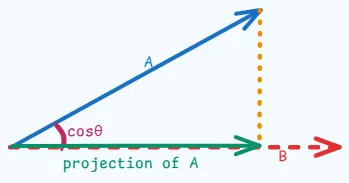
cosine similarity
From trigonometry,
It is saying, how much of a exists in the direction of b.
So, Dot Product is designed to measure the total impact of one vector moving along another.
#Cosine Similarity
This comes directly from the geometric definition above.
The vectors get normalized by dividing by lengths. This turns vectors a & b into unit vectors. And now only their alignment is left to compare.
- Result +1.0: Perfect Match ().
- Result 0.0: Orthogonal / No Relation ().
- Because .
- Result -1.0: Exact Opposites ().
#Shadow Caster
Drag the white arrow (vector A) or adjust the sliders to change its length and direction.
- The yellow line is the projection / shadow cast upon the green / ground vector.
- When the white arrow is straight up, shodow is gone and cosine similarity is 0, signifying orthogonality or independence.
- An obtuse angle or () represents negative correlation
With this, dot product and its geometric meaning is covered.