4. NLP: Seq2Seq
#Sequence-to-Sequence Models
Seq2Seq models are a neural network architecture designed to transform one sequence (of text) to another sequence.
The input and output are both sequences and can be of varying lengths.
These models can be used for many tasks like :
- Machine Translation
- Text Summarization
- Speech Recognition
- Image Captioning
This post will focus on Machine Translation task.
#Architecture
- It consists of a Decoder and an Encoder network.
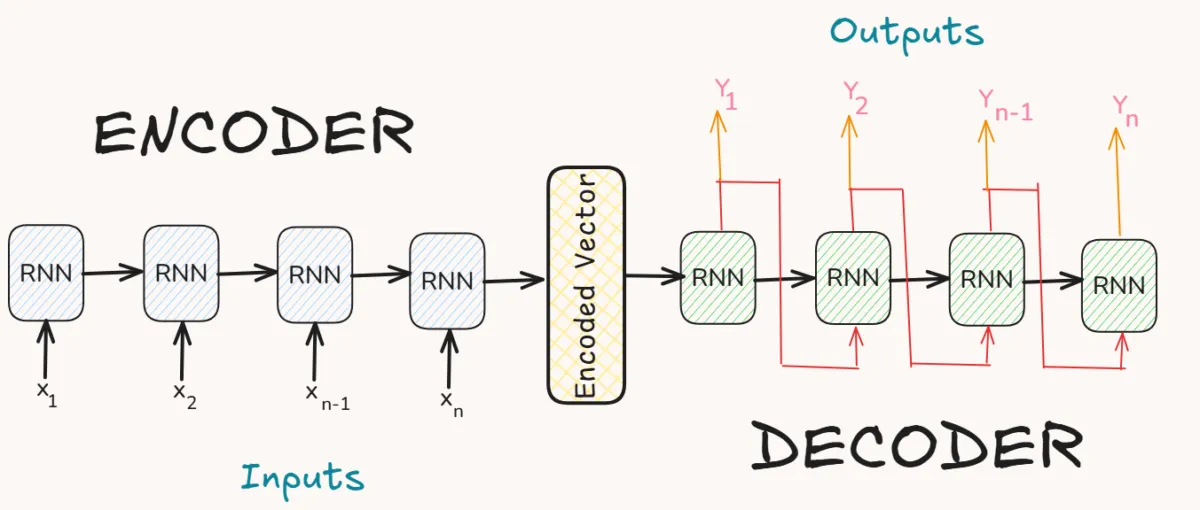
Architecture of Seq2Seq Models
#Encoder
- The encoder processes the entire input sequence and encodes it into a context vector (also called the hidden state).
- This context vector contains compressed information about the whole input sequence.
- This context vector is represented by the
- It is built using RNNs(LSTM or GRU).
class Encoder(nn.Module):
    def __init__(self, input_dim, embedding_dim, hidden_dim, n_layers, dropout):
        super().__init__()
        self.hidden_dim = hidden_dim
        self.n_layers = n_layers
        self.embedding = nn.Embedding(input_dim, embedding_dim)
        self.rnn = nn.LSTM(embedding_dim, hidden_dim, n_layers, dropout=dropout)
        self.dropout = nn.Dropout(dropout)

    def forward(self, src):
        embedded = self.dropout(self.embedding(src))
        outputs, (hidden, cell) = self.rnn(embedded) # embedded = [src length, batch size, embedding dim]

        return hidden, cell
#Decoder
- The decoder is also built using RNNs(LSTM or GRU) and is responsible for generating the output sequence token-by-token.
- The decoder's initial hidden state is set to the final hidden state of the encoder.
- It starts with a special start-of-sequence token
and generates one word at a time. - The decoder uses its own previous outputs as inputs at each step (during inference).
- During training, a technique called teacher forcing is used.
class Decoder(nn.Module):
    def __init__(self, output_dim, embedding_dim, hidden_dim, n_layers, dropout):
        super().__init__()
        self.output_dim = output_dim
        self.hidden_dim = hidden_dim
        self.n_layers = n_layers

        self.embedding = nn.Embedding(output_dim, embedding_dim)
        self.rnn = nn.LSTM(embedding_dim, hidden_dim, n_layers, dropout=dropout)
        self.fc_out = nn.Linear(hidden_dim, output_dim)
        self.dropout = nn.Dropout(dropout)

    def forward(self, input, hidden, cell):
        # input shape: [batch_size]
        if input.dim() == 2:
            input = input.squeeze(0)  # Ensure shape is [batch_size]

        input = input.unsqueeze(0)  # Reshape to [1, batch_size] for time-step=1
        embedded = self.dropout(self.embedding(input))  # [1, batch_size, embedding_dim]

        output, (hidden, cell) = self.rnn(embedded, (hidden, cell))
        prediction = self.fc_out(output.squeeze(0))  # [batch_size, output_dim]

        return prediction, hidden, cell
#Combined Seq2Seq Model
- These 2 classes are used to build the complete Seq2Seq class.
import torch
import torch.nn as nn
import random

class Seq2Seq(nn.Module):
    def __init__(self, encoder, decoder, device):
        super().__init__()
        self.encoder = encoder
        self.decoder = decoder
        self.device = device

    def forward(self, src, trg, teacher_forcing_ratio=0.5):
        # src = [src_len, batch_size]
        # trg = [trg_len, batch_size]

        batch_size = trg.shape[1]
        trg_len = trg.shape[0]
        trg_vocab_size = self.decoder.output_dim

        # Tensor to store decoder outputs
        outputs = torch.zeros(trg_len, batch_size, trg_vocab_size).to(self.device)

        # Encode the source sequence
        hidden, cell = self.encoder(src)

        # First input to the decoder is the <sos> token
        input = trg[0, :]  # [batch_size]

        for t in range(1, trg_len):
            # Decode one token
            output, hidden, cell = self.decoder(input, hidden, cell)

            # Store the prediction
            outputs[t] = output

            # Decide whether to use teacher forcing
            teacher_force = random.random() < teacher_forcing_ratio

            # Get the highest predicted token
            top1 = output.argmax(1)

            # Use actual next token or predicted token as next input
            input = trg[t] if teacher_force else top1

        return outputs
#Teacher Forcing
- Feeding the actual target token instead of the predicted one to help the model learn faster.
- Prevents the model from compounding its own early mistakes during training.
- At each time step
tuse the correct target prediction or the model's previous prediction based on a teacher_forcing_ratio.
if random.random() < teacher_forcing_ratio:
    input = trg[t]       # teacher forcing
else:
    input = model_pred   # use model's own prediction
Too much teacher forcing might cause model to struggle at inference time.
Too little teacher forcing will result in slower training.
Thus, scheduled sampling can be used : start with a high ratio and gradually decrease it over epochs.
The complete code can be found here
#Perplexity
- It is a metric to evaluate how well a language model predicts a sequence.
- It measures how surprised the model is by the actual target sequence.
Lower perplexity = less surprise = more confident predictions = better model.
- If the model assigns probabilities to a sequence of length T, the perplexity is :
- If loss function used is
nn.CrossEntropyLosswhich computes the negative log-likelihood, it can be exponentiated to get perplexity.
loss = nn.CrossEntropyLoss(output, target)
perplexity = torch.exp(loss) # np.exp(loss)
#Beam Search
It is a decoding strategy used to generate sequences.
Instead of choosing only the top-1 prediction at each step (as in greedy decoding), it keeps track of the top k most probable sequences at each step (where k is the beam width).
At each time step:
- Expand each sequence in the beam with all possible next tokens.
- Keep only the
top-ksequences based on total log probability. - Repeat until max length or end-of-sequence (
<eos>) token is reached.
#Drawbacks of Seq2Seq models
Entire input sequence is compressed into a single fixed-size (dimension of hidden state) context vector.
- This causes the model to struggle with long / complex sequences.
RNNs being sequential by nature doesn't allow parallization easily.
Beam search during inference adds computational overhead.
These models don't learn the explicit word-to-word alignment between input and output tokens.
#Solution
To tackle the above drawbacks Attention and Transformer architecture are used.